

Airport and port lighting projects are very different from ordinary road lighting.
In these environments, lighting poles are not just supporting structures for lamps. They are part of critical infrastructure where safety, visibility, and reliability directly affect daily operations.
A failure in lighting performance at an airport runway or a busy port area is not a minor issue. It can impact aircraft movement, cargo handling, navigation safety, and operational efficiency.
That is why lighting pole selection in these projects follows stricter standards compared to urban or commercial street lighting.
The focus is not only on brightness. It is on structural safety, corrosion resistance, wind load capacity, and long-term stability under extreme environmental conditions.
Airports and ports are typically open environments with strong and continuous wind exposure.
Unlike urban streets surrounded by buildings, there is little natural wind protection.
This means lighting poles must be designed to withstand high wind pressure without deformation or instability.
In most engineering projects, wind speed requirements are defined based on local meteorological data.
The pole design must consider:
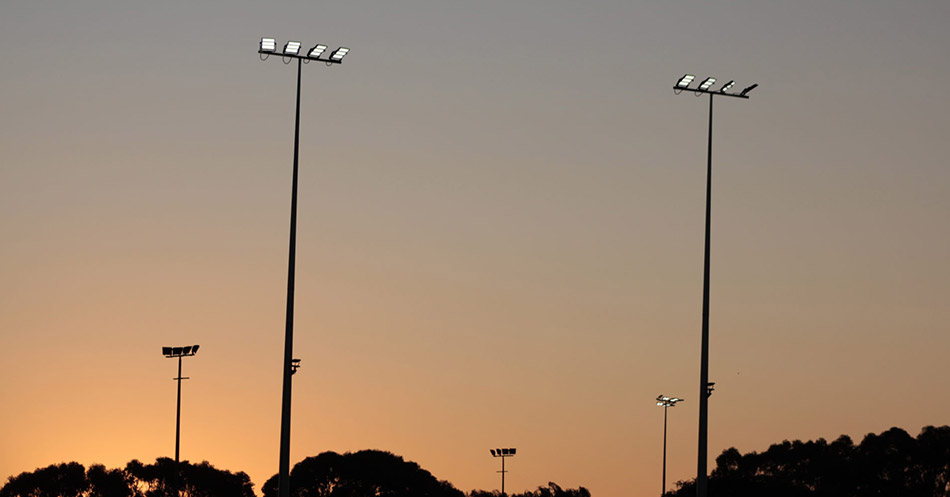
High mast lighting systems are commonly used in these areas because they provide better coverage with fewer poles, reducing obstacles in operational space.
For airports in particular, pole stability is a critical safety requirement rather than an optional design factor.
Ports are one of the most aggressive environments for steel structures.
Salt spray, humidity, and continuous exposure to seawater accelerate corrosion much faster than inland areas.
Because of this, surface protection becomes a key selection factor.
Common solutions include:
Among these, hot-dip galvanized steel remains the most widely used solution because it provides both internal and external protection.
In high-salinity environments, a single coating layer is usually not enough. Multi-layer protection systems are often required to ensure long-term durability.
Without proper anti-corrosion design, lighting poles may show visible deterioration in just a few years.
Airport and port areas require wide and uniform lighting coverage.
This is usually achieved through high mast lighting systems ranging from 15 meters to over 50 meters in height.
Higher poles allow:
However, increasing height also increases structural load and wind resistance requirements.
This creates a balance between coverage efficiency and structural safety.
Lighting design in these projects is always based on simulation rather than simple product selection.
The most commonly used material in airport and port lighting poles is hot-dip galvanized steel.
It offers a strong combination of:
Aluminum poles are rarely used in heavy-duty airport or port applications due to lower structural strength under extreme wind conditions.
Stainless steel is used in some special marine or coastal projects, but cost limits its large-scale application.
In most cases, galvanized steel remains the engineering standard.
Airport lighting systems must comply with aviation safety regulations.
One important requirement is obstacle limitation. Lighting poles must not interfere with flight paths or radar systems.
Key safety considerations include:
Ports also require compliance with heavy industrial safety standards, especially in container handling zones where large machinery operates continuously.
Lighting poles must remain stable even under accidental impact risk and vibration from nearby equipment.
In airports and ports, downtime is costly.
Lighting systems must be designed for easy maintenance without disrupting operations.
This affects:
High mast lighting poles often include internal or external lowering systems, allowing maintenance at ground level instead of requiring cranes.
This significantly reduces maintenance time and operational risk.
In these environments, uneven lighting is not acceptable.
Shadow zones, glare, or dark areas can directly affect safety during:
Therefore, lighting design must ensure:
This is achieved through a combination of pole height, fixture optics, and precise spacing design.
Many project issues come from focusing only on price or appearance.
Common mistakes include:
In airport and port projects, these mistakes are costly and difficult to correct after installation.
Contact Us
Get a custom lighting solution and quotation for your project. Outdoor lighting manufacturer in Yangzhou, ChinaAbout Jieyao LightingYangzhou Jieyao Lighting Equipment Co., Ltd. is an outdoor lighting manufacturer focused on solar street light systems and high mas... Do you have any questions or requests?
Email: jay@jieyaolighting.com

Click to Chat.
Im online now.