
 English
 Español
 Bahasa Indonesia

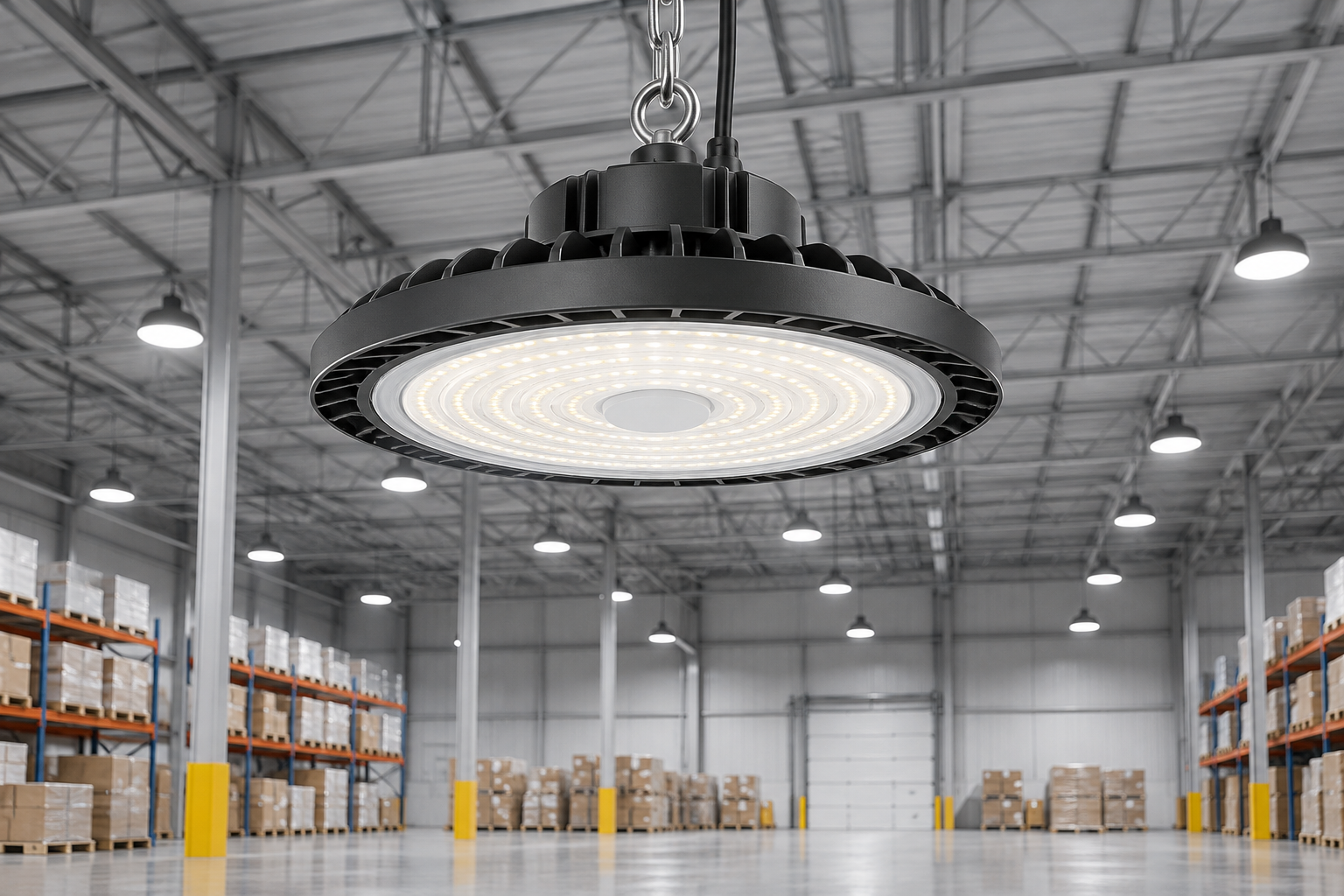
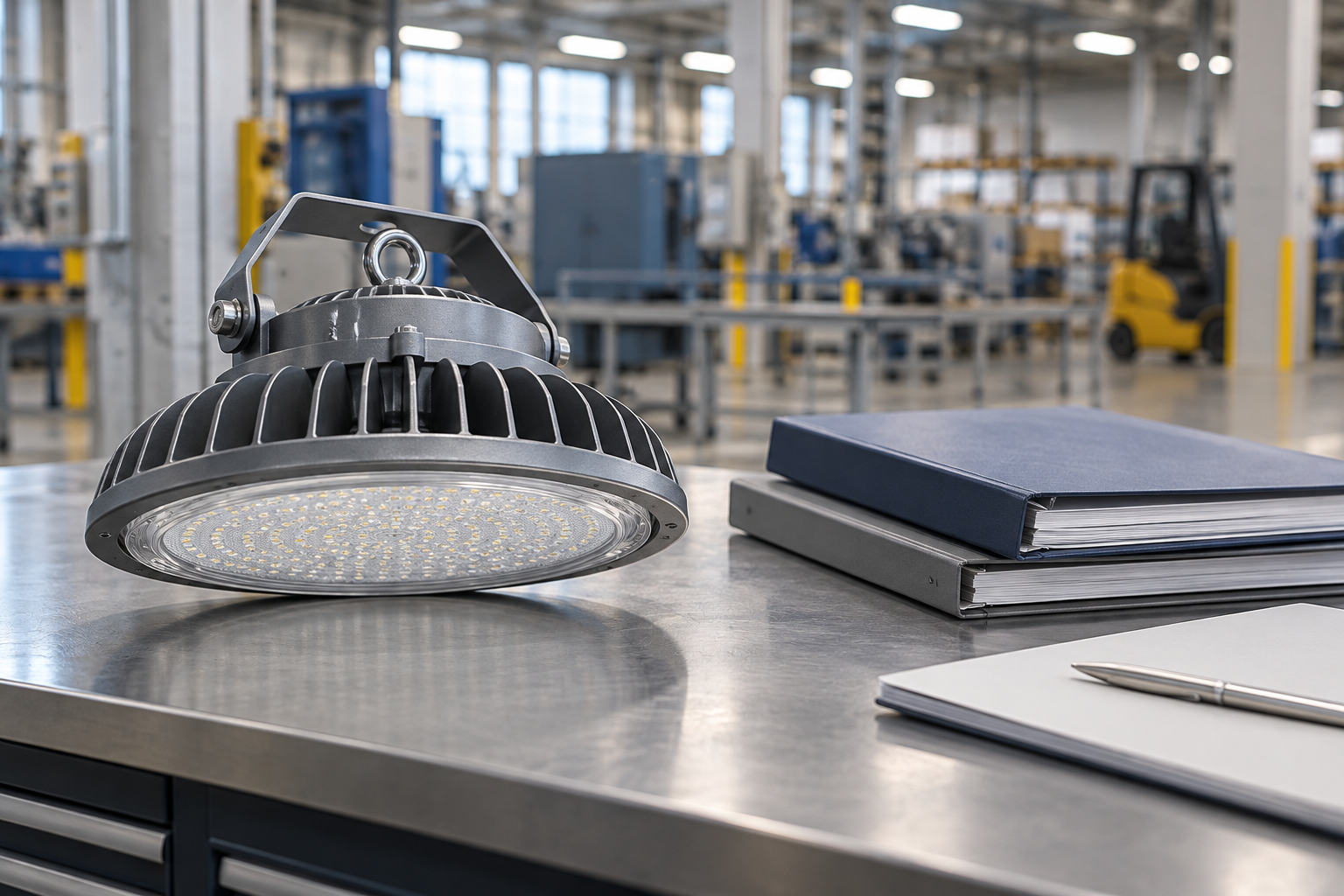
Quick answer: A UFO LED high-bay light is a compact, generally round high-bay luminaire format used in project discussions for spaces with elevated mounting positions. Select it by the actual installation height, task, layout, required light distribution, electrical system and control plan—not by the “UFO” shape or a wattage label alone. Jieyao offers the UFO LED high-bay product family; exact model data and suitability must be confirmed against the project and the selected product documentation.
What the “UFO high bay” name describes
“UFO” commonly describes the round, low-profile form of a high-bay luminaire. The term identifies a visual category, not a single optical design or performance level. Products with a similar housing shape can differ in LED board, driver, thermal design, optics, mounting method, controls and approvals. A buyer should therefore request the complete model designation and product data rather than treating the category name as a specification.
High-bay lighting is considered where luminaires are mounted above the working plane, such as some warehouses, workshops, production spaces or large commercial interiors. Whether a specific fixture is appropriate depends on the room geometry, tasks, mounting position, environmental conditions and applicable lighting requirements.
Start with the room and the task
Before comparing products, gather a reflected ceiling or installation plan, room dimensions, mounting heights, structural mounting points, work-plane information and the locations of aisles, machines, racks or other obstructions. Describe whether the space is used for general movement, storage, inspection, assembly or another task. These inputs help a lighting designer evaluate quantity, spacing, aiming and distribution.
Do not choose a high-bay fixture solely by lumen output or nominal watts. The layout and optical distribution determine where light reaches, while surface reflectance, mounting height and obstructions affect the result. A project may need a photometric calculation using the exact luminaire file and stated maintenance assumptions. Ask for the basis of any proposed layout so it can be reviewed against the project brief.
UFO high-bay selection checklist
| RFQ input | What the project team should provide | What to confirm from the offered model |
|---|---|---|
| Application and task | Room use, work areas, safety-critical activities and operating schedule | Whether the proposed distribution and configuration are intended for the task |
| Geometry and mounting | Room plan, mounting height, ceiling/structure and obstructions | Mounting hardware and installation constraints for the exact model |
| Photometric requirement | Target criteria, calculation boundary and design assumptions | Current photometric file and model/optic identity used in the calculation |
| Electrical supply | Voltage/frequency and project electrical requirements | Input range, driver details and connection method in the model datasheet |
| Environment | Ambient conditions, dust, moisture, cleaning and chemical exposure | Model-specific enclosure and temperature limits supported by documents |
| Controls | Switching, dimming, sensor or network requirements | Supported control method, wiring and compatibility for the selected driver |
| Approvals and submittal | Destination market and project-required documents | Exact certificates and scope applicable to the offered model and market |
Plan spacing and visual comfort
Even a suitable product can produce poor results if the layout ignores mounting geometry or the work being done. Review spacing, overlap, shadows from racks or machinery, glare from the observer’s viewpoints and light reaching adjacent areas. Where people work with reflective surfaces or look upward frequently, assess glare and visual comfort as part of the design rather than treating them as afterthoughts.
For irregular ceilings or changing production layouts, record which areas must remain illuminated if equipment moves. Confirm whether maintenance access, lifting equipment, sprinkler systems, HVAC ducts or overhead services interfere with the proposed fixture positions. The final schedule should identify the selected model and optic for each area.
Installation and maintenance considerations
Confirm the mounting method, suspension or bracket requirements, access for servicing, cable routing and any required isolation procedure before ordering. These details are project-specific and should follow the luminaire manual and local electrical rules. Establish who will inspect or clean the fixture and how replacement parts will be identified; do not assume that visually similar high-bay products share interchangeable components.
For sites with dust, moisture, heat, vibration or corrosive agents, obtain the exact model’s documented limits and compare them with the conditions at the installation point. The generic term “high bay” does not establish an IP rating, operating temperature, impact rating or approval.
Documents to request before approval
- Full model number and revision-controlled datasheet.
- Photometric file corresponding to the exact optic and configuration offered.
- Electrical input and driver/control information for the destination market.
- Installation and maintenance instructions, including mounting details.
- Model-specific test reports or certificates required by the project, with scope and validity confirmed.
- Clearly identified substitutions or options, so the approved schedule remains unambiguous.
Frequently asked questions
What is a UFO LED high-bay light?
It is a round, compact-form high-bay luminaire category. The name does not define the product’s output, optics, electrical data or certifications; check the exact model documentation.
Are UFO high bays suitable for every warehouse?
No single format suits every layout or task. Room geometry, mounting, optics, environment and required lighting criteria must be assessed for the specific project.
How many UFO high-bay lights does a facility need?
There is no reliable universal fixture count. Use a layout or photometric calculation based on the actual room, mounting height, work areas, selected model and design assumptions.
Can I compare high bays by watts alone?
No. Watts describe electrical input, not the distribution or maintained lighting result. Compare the exact photometric and electrical documents against the same project criteria.
What should I send for a UFO high-bay quotation?
Provide the room plan, mounting information, task, environmental conditions, electrical supply, control needs, destination market and required submittals. Ask the supplier to identify the model and supporting documents for each proposed configuration.
Jieyao’s UFO LED high-bay family is available for project discussion. Share the application and required documents through the project enquiry form; model-specific ratings, optics and approvals must be confirmed in the quotation documents before selection.