
 English
 Español
 Bahasa Indonesia

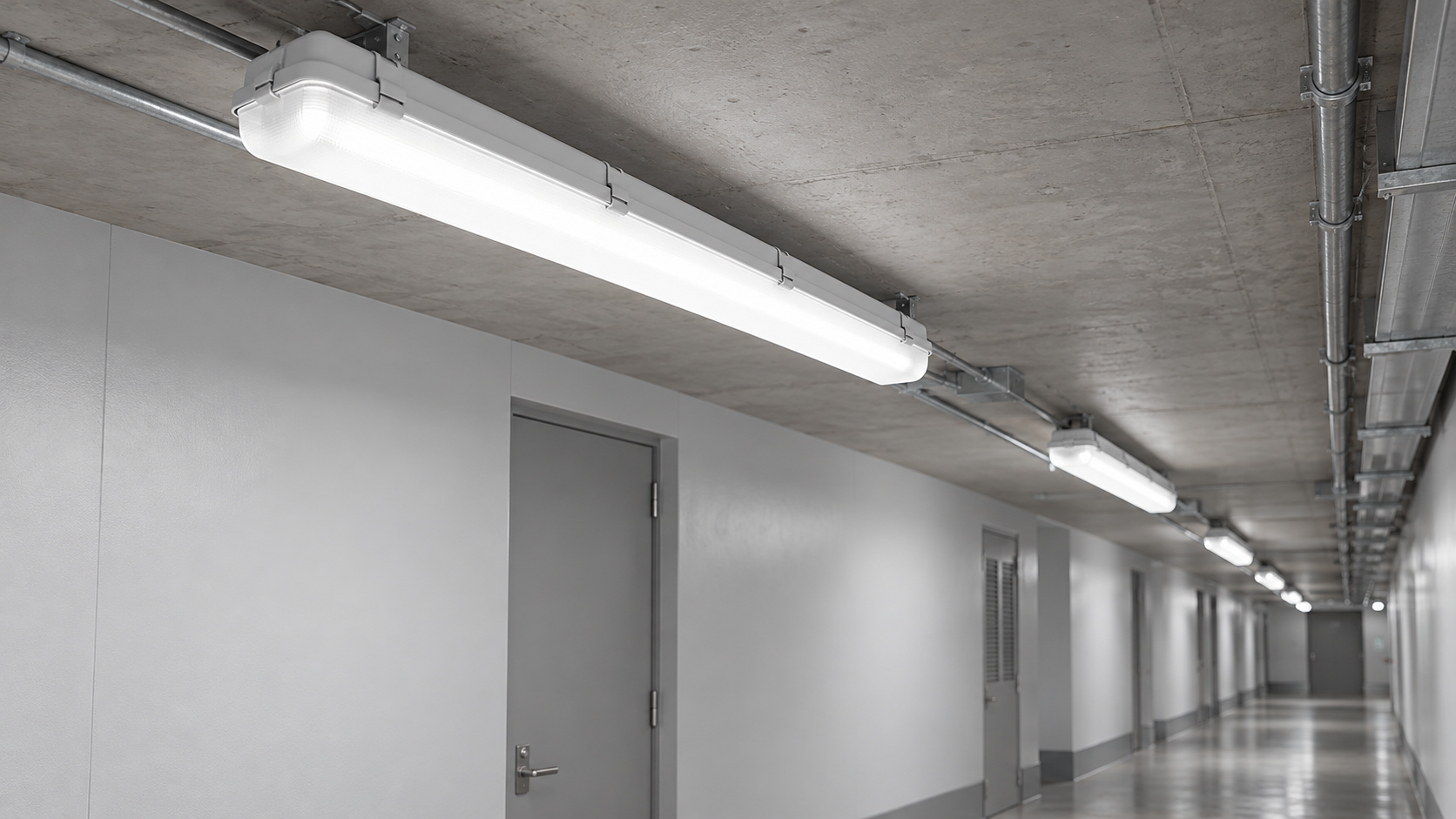
Quick answer: “Tri-proof” is a market label often used for luminaires intended to address water, dust and corrosion exposure, but the term alone does not establish a tested protection level or suitability for a particular site. Specify a tri-proof LED light by the actual environment, mounting arrangement, task, electrical supply and required documentation. Jieyao confirms this product family is offered; every rating and configuration must be verified for the exact model before approval.
Why the tri-proof label needs a datasheet
Suppliers may use “tri-proof” differently. Similar-looking linear luminaires can have different enclosure construction, seals, materials, optical covers, cable entries, fasteners, drivers and test evidence. The label is not a substitute for a model number or a report that identifies the tested configuration.
Start by describing what the fixture will experience: water exposure, dust, cleaning method, condensation, airborne chemicals, temperature, impact risk and installation orientation. Then ask the supplier to identify which of those conditions the offered model is documented to withstand. Avoid translating a general marketing phrase into a specific IP or impact rating unless the model’s valid evidence supports it.
Match the luminaire to the application
Tri-proof fixtures are commonly considered for utility or industrial spaces where a linear enclosed luminaire is desired. The appropriate design depends on the actual task and mounting conditions. A storage aisle, washdown area, workshop, covered passage and cold or hot process space can impose different requirements. The project description should name the location and exposure rather than merely saying “industrial.”
Record the mounting surface, height, orientation, available wiring, access for maintenance and any obstructions. For a replacement project, document the existing fixture dimensions and connection method, but do not assume a new product is a drop-in replacement solely because the housing looks similar.
Tri-proof LED light RFQ checklist
| Topic | Project detail to state | Evidence to request for the exact model |
|---|---|---|
| Exposure | Water source, dust type, cleaning chemicals, humidity and condensation | Applicable test report and documented enclosure limitations |
| Mechanical risk | Possible impact, vibration, handling or accidental contact | Model-specific impact evidence if required by the project |
| Temperature | Expected ambient conditions and nearby heat sources | Documented operating range and any output or lifetime derating conditions |
| Lighting task | Work plane, visual task, mounting position and target design criteria | Photometric data for the offered configuration |
| Electrical supply | Voltage, frequency, switching and any emergency/control requirements | Input data, driver specification and supported interface |
| Installation | Surface, suspended or other mounting; cable entry direction and access | Installation drawing and compatible mounting accessories |
| Compliance | Destination country and required standards or approvals | Certificates that identify holder, model scope and valid product variant |
Review light distribution and electrical details
Check that the proposed optical distribution suits the room rather than relying on fixture length or nominal wattage. Ask for the photometric file and calculation inputs where a designed layout is required. Confirm whether the reported light output refers to the complete luminaire and whether the document matches the exact cover, optic and driver offered.
Electrical details also matter during replacement or new construction. Confirm input range, frequency, driver behavior, connection method, inrush considerations where relevant and compatibility with any control or emergency system. These are model-specific; do not infer them from the product category.
Installation, inspection and maintenance
Follow the installation instructions for the selected model, including mounting, cable entry and sealing procedures. If a fixture is opened in service, the responsible technician should restore it according to the manufacturer’s method. A damaged seal, incorrect cable gland or unsuitable cleaning method can compromise the protection expected from an enclosure.
Plan inspection around the site’s operating conditions and the manufacturer’s instructions rather than assigning a universal interval. Record cleaning methods, visible enclosure damage, discoloration, water ingress, loose fittings and any driver or control faults. Replacement parts should be identified by exact model and revision.
Common procurement mistakes
- Treating “tri-proof” as a guaranteed IP, IK or corrosion rating.
- Choosing a fixture without describing the water, dust, chemical and temperature exposure.
- Assuming look-alike housings have the same driver, optics or replacement parts.
- Approving a certificate that does not cover the exact model or destination market.
- Using a general wattage comparison instead of reviewing the full luminaire and photometric basis.
- Changing cable entries or mounting details without checking the tested installation method.
Frequently asked questions
What does tri-proof mean in LED lighting?
It is a common product label associated with resistance to water, dust and corrosion, but suppliers do not use it as a precise rating. Verify the exact model’s construction and supporting documents.
Does every tri-proof light have the same IP rating?
No. A category name does not establish a specific IP rating. Check the model datasheet and relevant test evidence for the configuration being quoted.
Can a tri-proof light be used outdoors?
Do not infer outdoor suitability from the label. Review the installation location, exposure, mounting, temperature and model-specific evidence against the project conditions.
How do I select a tri-proof light for a washdown area?
Describe the cleaning method, water pressure and direction, temperature, chemicals, mounting orientation and frequency to the supplier. Obtain written confirmation and evidence for the exact fixture and installation method.
What documents should accompany a tri-proof LED quotation?
Request an identified model and revision, complete datasheet, photometric file when needed, installation instructions, applicable test reports or certificates, and a clear list of included accessories and options.
Jieyao offers a tri-proof LED product family for project review. Send the application details and request model-matched documentation for the actual exposure and destination market before specifying the luminaire.