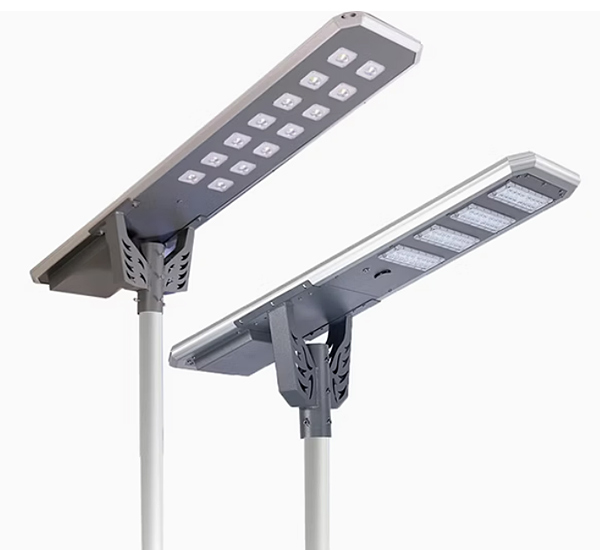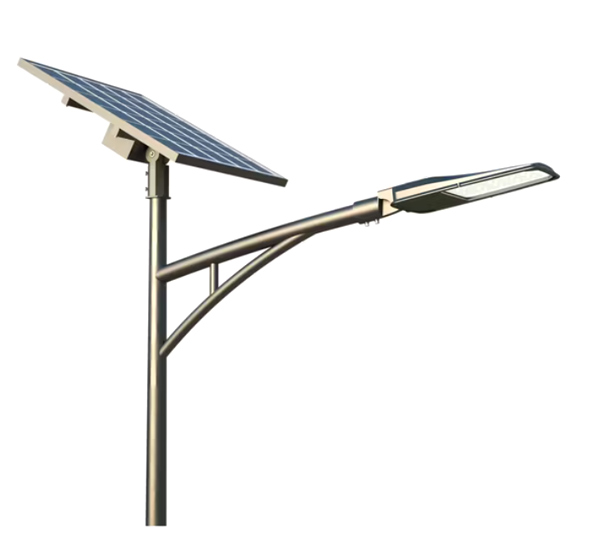


When buyers ask for a “100W solar street light,” the first question a professional supplier usually asks is not the wattage.
It is: Where will the light be installed?
A 100W light for a village road and a 100W light for a six-lane highway are completely different projects. The same wattage does not mean the same brightness, and it certainly does not guarantee the same lighting effect.
This is where many projects go wrong.
People often use watts to judge brightness, but in LED solar street lighting, the more useful number is actually lumens.
Watts tell you how much power the lamp uses.
Lumens tell you how much visible light the lamp produces.
If the lumen output is too low, the road stays dark and safety becomes a problem. If the system is oversized, the project budget increases, and the battery and solar panel costs rise with it.
Good lighting design is not about choosing the highest wattage. It is about choosing the right brightness for the real application.
Lumen (lm) is the unit used to measure the total light output of a lamp.
The higher the lumen value, the brighter the lamp appears.
For example, two lamps may both be marked as 100W, but if one uses better LED chips and a more efficient driver, its actual brightness can be much higher.
That is why professional buyers look at luminous efficiency (lm/W) instead of wattage alone.
| LED Power | Typical Lumen Output |
|---|---|
| 30W | 3,600–4,500 lm |
| 50W | 6,000–7,500 lm |
| 100W | 12,000–15,000 lm |
| 150W | 18,000–22,000 lm |
| 200W | 24,000–30,000 lm |
These figures vary depending on chip brand, optical lens design, heat dissipation, and driver quality.
This is why cheap products with “high wattage” labels often perform poorly on site.
Lighting design usually starts with one simple question:
How much light is needed on the ground?
The basic reference formula is:
\text{Required Lumens} = \text{Illuminance (lux)} \times \text{Lighting Area (m^2)}
Here:
For example, if a parking area needs 20 lux and the total lighting area is 500 square meters:
20×500=10,000 lumens20 \times 500 = 10,000\ \text{lumens}20×500=10,000 lumens
This means the project needs around 10,000 lumens of effective lighting.
This is not the final purchase number yet, because pole height, beam angle, and light loss also affect the real result.
But it gives a solid starting point.
Not every road needs the same brightness.
Lighting standards depend on traffic flow, safety requirements, and local project specifications.
Installing excessive brightness does not improve the project—it only increases cost.
| Application | Recommended Lux |
|---|---|
| Residential Roads | 10–15 lux |
| Main Urban Roads | 15–30 lux |
| Highways | 20–50 lux |
| Parking Lots | 10–20 lux |
| Industrial Areas | 20–30 lux |
| Parks and Walkways | 5–15 lux |
| Stadium Surroundings | 30–50 lux |
This is why asking only for “the brightest solar street light” usually leads to the wrong solution.
Brightness should match actual usage.
One common mistake is choosing the lamp first and thinking about the pole later.
In reality, pole height directly affects ground brightness.
The higher the pole, the larger the lighting coverage area. But if lumen output stays the same, the brightness on the ground becomes weaker.
That is why a 30W lamp may work well on a 5-meter pole but fail completely on a 10-meter pole.
| Pole Height | Suggested LED Power |
|---|---|
| 4–5 meters | 20W–40W |
| 6–7 meters | 40W–80W |
| 8–10 meters | 80W–150W |
| 10–12 meters | 150W–200W+ |
This is only a reference, not a fixed rule.
Road width and installation spacing must also be included in the design.
Many buyers compare only lumen numbers and ignore beam angle.
This creates problems later.
A narrow beam concentrates light in a smaller area and creates stronger center brightness.
A wide beam spreads light over a larger area but reduces brightness intensity.
For roads and highways, good optical distribution is often more important than simply increasing wattage.
A well-designed lens improves road uniformity, reduces dark spots, and makes the project safer without increasing energy consumption.
This is where professional street lighting differs from ordinary outdoor lamps.
More brightness means more power consumption.
That affects the entire system.
If the LED power increases, the following usually increase as well:
For example, changing from 50W to 100W is not simply doubling brightness.
It may also mean a much larger lithium battery and a larger solar panel to maintain stable lighting during cloudy days.
This is why experienced buyers do not chase high wattage blindly.
They look for balance.
A well-matched system lasts longer and costs less to maintain.
Many projects fail because the quotation starts with only one sentence:
“I need a 100W solar street light.”
This is not enough.
Without project details, wattage alone has little meaning.
| Common Mistake | Result |
|---|---|
| Choosing by wattage only | Wrong brightness level |
| Ignoring rainy days | Battery shortage |
| Buying low lm/W products | Poor actual lighting |
| Ignoring pole spacing | Uneven road brightness |
| No lighting simulation | Higher maintenance later |
Street lighting is a system project, not a single-product purchase.
To make accurate recommendations, manufacturers usually need a few basic details first.
| Information | Why It Matters |
|---|---|
| Road Width | Determines coverage area |
| Pole Height | Affects brightness on the ground |
| Pole Distance | Impacts lighting uniformity |
| Installation Country | Climate affects charging efficiency |
| Lighting Hours per Night | Battery sizing |
| Backup Rainy Days | Battery reserve planning |
With these details, suppliers can provide proper lighting simulation instead of rough estimates.
This avoids overspending and reduces maintenance risk later.
Solar street light brightness is never decided by wattage alone.
Lumens, lux requirements, pole height, beam angle, battery capacity, and solar panel sizing all work together.
A brighter light is not always a better light.
The right light is the one that delivers stable performance, safe visibility, and reasonable long-term cost.
For roads, parking lots, highways, and municipal projects, proper lumen calculation is not just a technical detail.
It is the difference between a successful project and an expensive mistake.
Contact Us
Get a custom lighting solution and quotation for your project. Outdoor lighting manufacturer in Yangzhou, ChinaAbout Jieyao LightingYangzhou Jieyao Lighting Equipment Co., Ltd. is an outdoor lighting manufacturer focused on solar street light systems and high mas... Do you have any questions or requests?
Email: jay@jieyaolighting.com

Click to Chat.
Im online now.