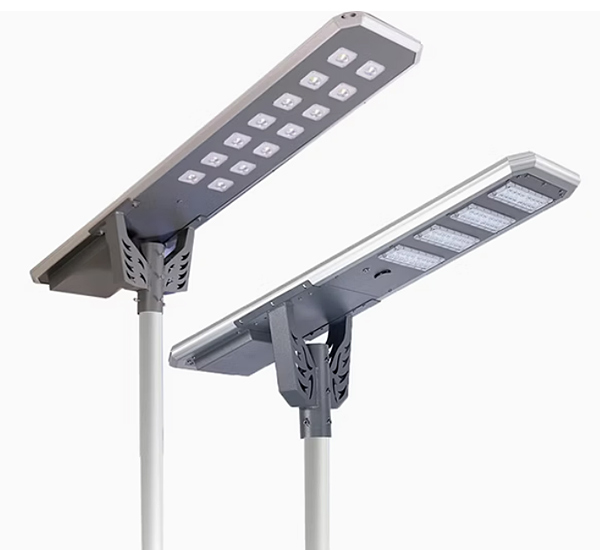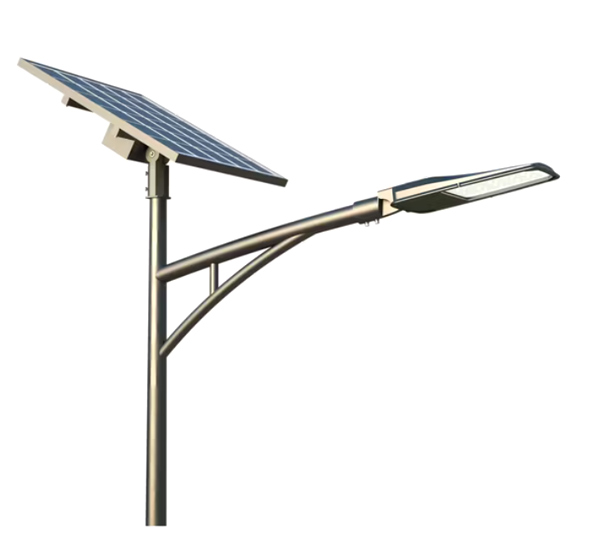


The operational stability of solar street lights in high-temperature or sub-zero environments is determined by component-level thermal management. For solar LED street lighting deployed in critical infrastructure, such as highways, the system must maintain a high autonomy buffer despite environmental stress.
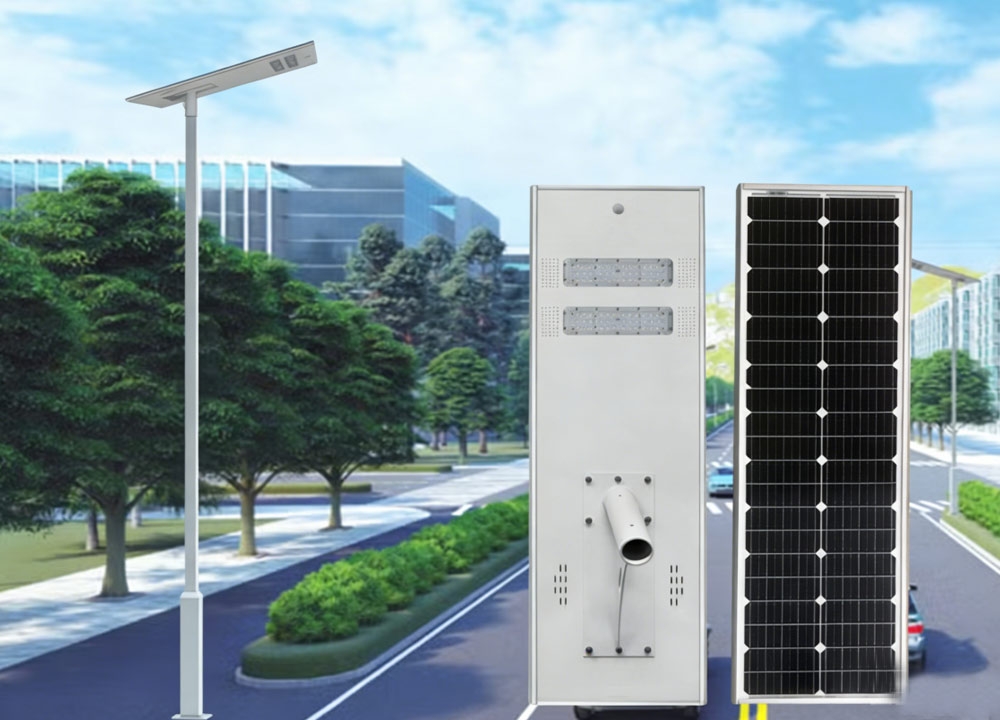
The energy storage unit is the most temperature-sensitive element of a solar powered street lamp.
High-Temperature Performance ($+70$°C): We utilize LiFePO4 (Lithium Iron Phosphate) chemistry, which offers a higher thermal runaway threshold than standard lithium-ion. The integrated BMS (Battery Management System) performs active monitoring, utilizing a high-temp cut-off to prevent cell degradation during peak summer heat.
Low-Temperature Charging ($-40$°C): Standard lithium batteries cannot accept a charge below $0$°C without permanent damage. For high-latitude projects, our integrated solar street lights feature proactive self-heating technology. A dedicated heating element, powered by the solar panel, warms the battery enclosure to optimal charging temperatures ($>5$°C) before the MPPT controller initiates the energy transfer.
In solar LED street lights, the controller manages high-frequency switching which generates internal heat.
Thermal Potting: To ensure a service life exceeding 10 years, our MPPT controllers are encapsulated in a thermal-conductive resin within a die-cast aluminum housing. This configuration dissipates heat effectively, preventing logic errors or frequency shifts even when ambient temperatures reach $+70$°C.
Voltage Compensation: The system automatically adjusts charging parameters based on real-time temperature data, ensuring the solar lighting system reaches a full state-of-charge during the low-irradiance days of winter.
Atmospheric Pressure Equalization: Rapid temperature drops can create a vacuum inside the solar luminaire, pulling in moisture. We integrate a ventilation breather valve that balances internal and external pressure while maintaining an IP66 rating, preventing condensation on the LED modules.
Material Fatigue Resistance: The chassis of our solar street lighting units is finished with a marine-grade, UV-stabilized powder coating (tested per ISO 9227). This prevents the housing from becoming brittle in extreme cold or oxidizing in humid, high-heat coastal environments.
High ambient heat accelerates lumen depreciation. Our solar LED street lighting maintains a junction temperature below $65$°C through passive convection. This keeps the Luminous Efficacy at a constant $190\text{ lm/W}$, ensuring the fixture meets EN 13201 lighting classes throughout its $100,000$-hour (L70) lifespan.
| Component | Arctic Specification (−40°C) | Tropical Specification (+70°C) |
| Battery Array | Self-heating LiFePO4 (BMS Managed) | Thermal-insulated enclosure |
| Solar Module | Snow-load rated tempered glass | PERC Monocrystalline (Low-temp Coeff.) |
| Control System | Low-temperature grade capacitors | High-pressure die-cast heat sinks |
| Structural Seal | Low-temp silicone (Anti-cracking) | IP66 / IK10 certified |
Get your competitive pricing today,
contact our experts directly at
Email:mr.xu@yzldzm.com
WhatsApp: +86 13815843784
or explore our full range at www.jieyaolighting.com
Contact Us
Get a custom lighting solution and quotation for your project. Outdoor lighting manufacturer in Yangzhou, ChinaAbout Jieyao LightingYangzhou Jieyao Lighting Equipment Co., Ltd. is an outdoor lighting manufacturer focused on solar street light systems and high mas... Do you have any questions or requests?
Email: jay@jieyaolighting.com

Click to Chat.
Im online now.