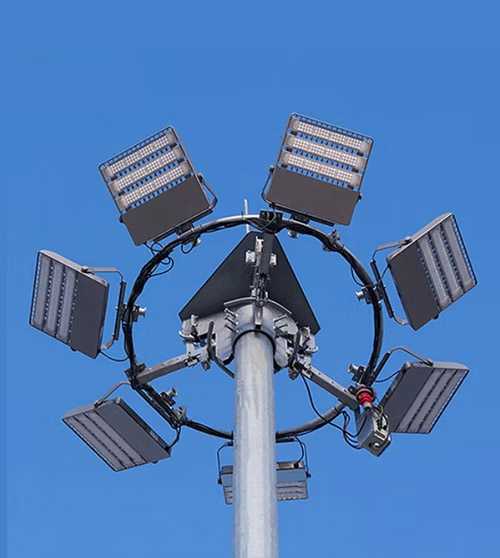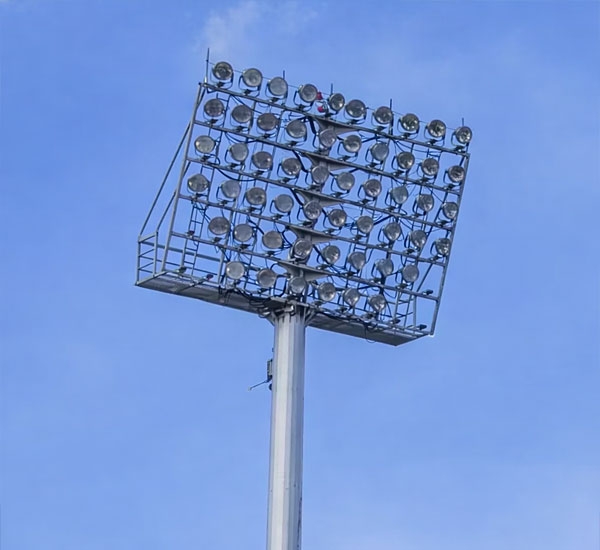


Our High Mast Light is designed with a smart lifting system that makes maintenance a one-man job from the ground. It starts with a heavy-duty electric winch built into the base of the High Mast Lighting pole. This winch pulls high-strength stainless steel cables through a precision pulley block at the very top of the mast.
This mechanism allows you to raise or lower the entire lamp carriage smoothly and safely. But the most important part is the automatic latching system. Once the High Mast Light reach the top, they "click" into a secure locked position. This is a lifesaver because it takes all the tension off the steel cables while the lights are working. You don't have to worry about cable fatigue or the carriage slipping—it’s locked tight until you’re ready to bring it down for a quick bulb change or cleaning.
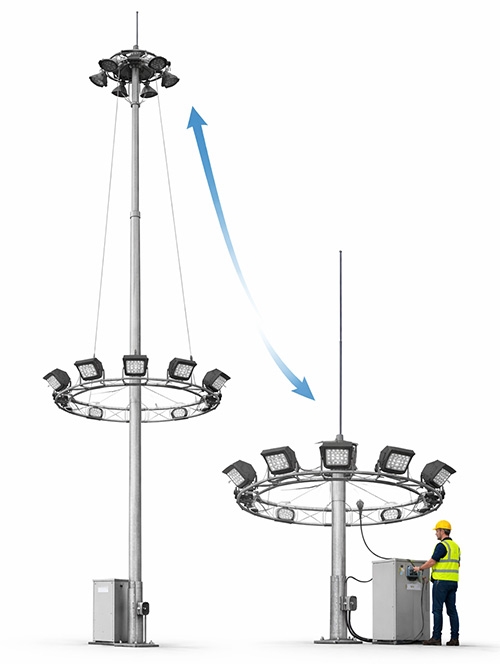
The system operates on a combination of mechanical leverage, electric motor drive, and automatic locking mechanisms. It can be broken down into four primary stages:
At the base of the pole, inside a locked compartment, sits the winch assembly.
Mechanism: A reversible electric motor (often portable or internally fixed) drives a worm gear winch.
Function: This winch reels in or lets out high-tensile stainless steel wire ropes. Most systems use a double-drum winch to prevent the cables from tangling or twisting during operation.
The stainless steel wire ropes run from the winch at the base, up through the hollow center of the mast, to the headframe (the top of the pole).
Top Pulley Block: At the mast head, there is a set of heavy-duty pulleys (sheaves). These pulleys redirect the vertical pulling force to the exterior of the pole where the lamp ring is attached.
Cable Configuration: Usually, three separate wire ropes are used to ensure the lamp ring remains perfectly level during ascent and descent.
While the steel ropes handle the weight, a flexible, multi-core electrical power cable supplies electricity to the lamps.
Synchronization: This cable is attached to the lifting mechanism so that it moves at the same speed as the lamp ring, preventing it from snagging or stretching.
Connection: When the ring is at the top, the cable is energized. During maintenance at the bottom, it can be plugged into a test power socket at the base to check the bulbs.
This is the most critical safety feature. Once the lamp ring reaches the top:
Automatic Latching: A mechanical "hook" or "latch" system engages. The weight of the lamp ring is transferred from the wire ropes onto the structural headframe of the pole.
Unloading: This ensures that the steel cables are not under constant tension for years at a time, preventing "creep" or snapping due to fatigue.
Visual Confirmation: Most systems include a flag or mechanical indicator to show the operator on the ground that the ring is securely locked.
Get your competitive pricing today,
contact our experts directly at
Email:mr.xu@yzldzm.com
WhatsApp: +86 13815843784
or explore our full range at www.jieyaolighting.com
Contact Us
Get a custom lighting solution and quotation for your project. Outdoor lighting manufacturer in Yangzhou, ChinaAbout Jieyao LightingYangzhou Jieyao Lighting Equipment Co., Ltd. is an outdoor lighting manufacturer focused on solar street light systems and high mas... Do you have any questions or requests?
Email: jay@jieyaolighting.com

Click to Chat.
Im online now.