

Short answer: A higher specified steel yield strength can allow a designer to consider a different shaft section, but Q345B is not a universal requirement for every high mast, nor does grade alone establish wind resistance, fatigue life or safety. The responsible engineer should choose an available grade and standard edition for the actual height, headframe/luminaire loads, site wind basis, shaft geometry, welded details, foundation interface and service conditions. Ask the fabricator for traceable mill certificates and approved calculations for the final configuration.
A grade name alone cannot establish a universal height cutoff, a one-to-one foreign-standard equivalence, or a fixed improvement in wind resistance, fatigue life or maintenance. Steel properties depend on the named standard edition, product form, thickness, delivery condition and mill-test results. Structural capacity depends on section dimensions and details as well as material; fatigue behaviour is often governed by the loading spectrum and welded/detail category, not just nominal yield strength. The steel grade also does not define coating durability.
The tender may still use the legacy Q345B designation. Before quoting it, confirm which governing standard edition and current grade designation are acceptable to the project engineer. China's official standards catalogue lists GB/T 700-2006 for carbon structural steels and GB/T 1591-2018 for high-strength low-alloy structural steels. The newer GB/T 1591 edition changes the grade framework; a blanket word-for-word equivalence to a European or ASTM grade is not a substitute for checking chemical, mechanical, toughness, weldability and delivery requirements. State the actual ordered grade and standard on the pole schedule and certificate.
| Decision input | What to request | Why the grade label alone is insufficient |
|---|---|---|
| Structural design basis | Applicable code, wind and dynamic actions, serviceability and approval responsibility | A nominal strength cannot determine required shaft/base capacity without loads and geometry |
| Steel designation | Standard edition, grade, product form, thickness range and delivery condition | A legacy Q345B label may not identify the currently ordered material |
| Verified material properties | Heat/lot traceability and mill test report with the project-required tests | Values and test scope must match the supplied plate or coil, not an online comparison chart |
| Welded and fatigue-critical details | Joint drawings, weld procedure/inspection scope and fatigue review where applicable | Higher yield strength by itself does not remove vibration or weld-detail fatigue risk |
| Corrosion system | Galvanizing/duplex specification, vent/drain detail and repair criteria | Material grade and protective-coating performance answer different questions |
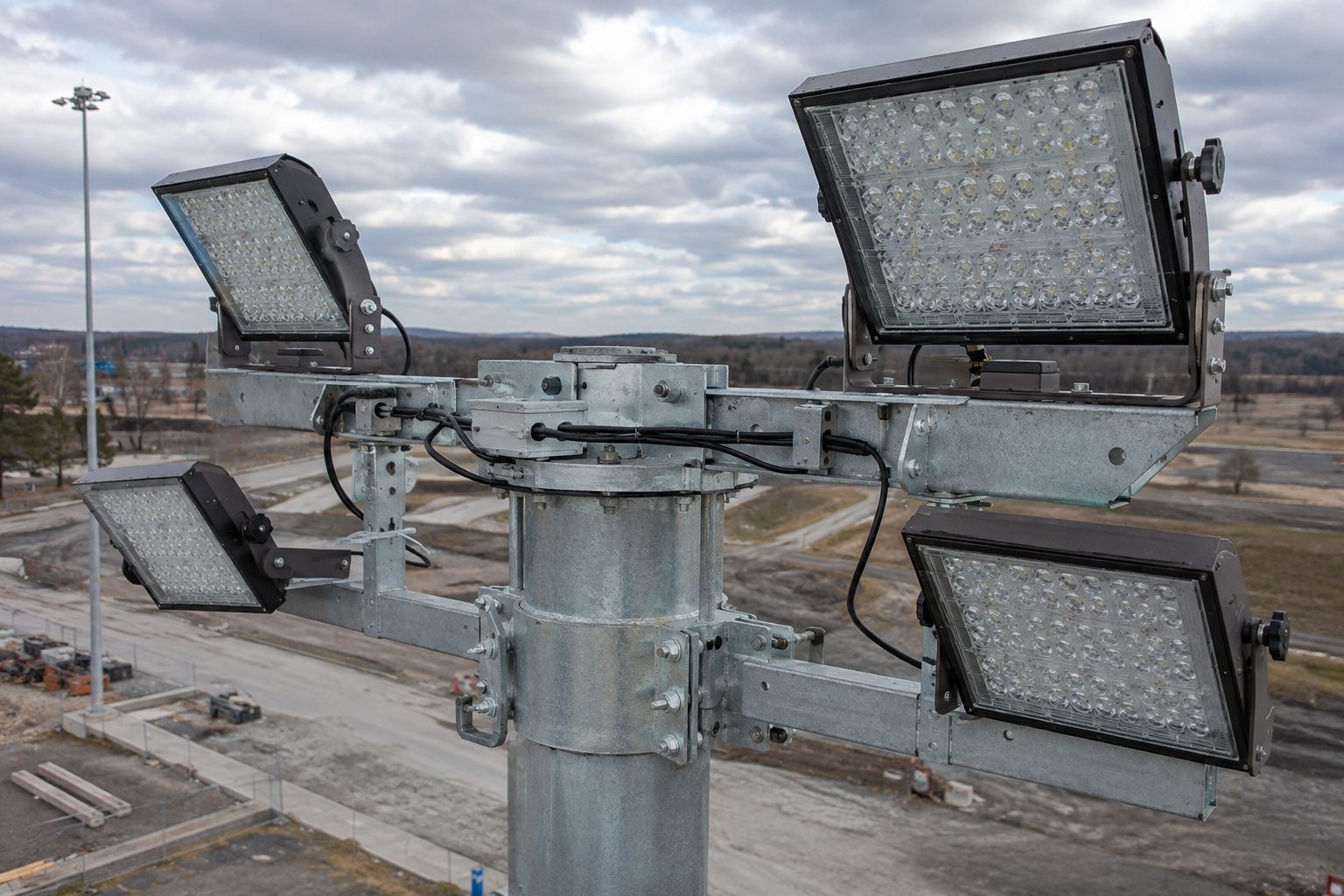
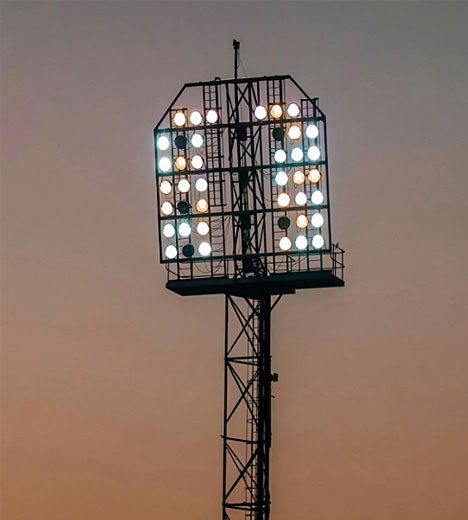
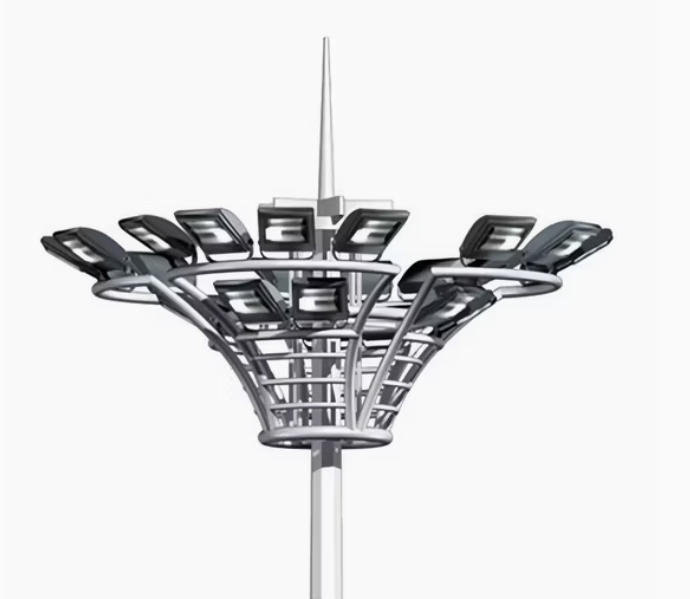
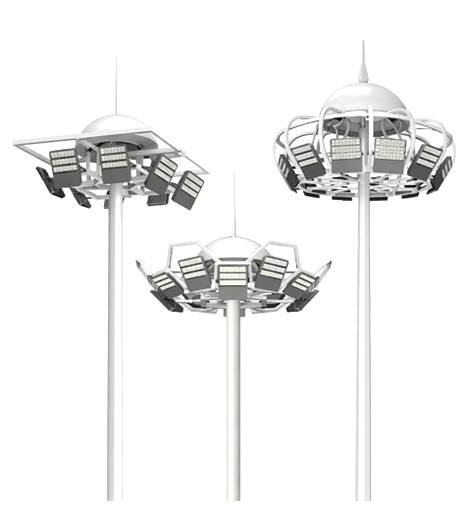
High-mast headframe and luminaire assembly illustrate the configured load, not the steel grade.
For a fair quotation, compare two engineered alternatives under the same site actions and equipment schedule. A higher-strength material may permit a revised section, but the design must still check deflection, local buckling, welds, openings, slip joints, base plate and anchors. A heavier section in a lower-grade steel can be a valid design where the calculations, fabrication and approval permit it. Conversely, a higher-grade thin section is not automatically better for fabrication, vibration or coating. Neither option should be sold with a generic height cutoff or wind-speed badge.
| Question for the buyer/engineer | Evidence in the offer | Hold point before fabrication |
|---|---|---|
| Is the grade available under the specified edition? | Named standard/grade and supply route | Approve any proposed substitution or cross-standard comparison |
| Are loads and shaft geometry identical across alternatives? | Load schedule, drawings, section/wall schedule and calculation summary | Recalculate changed height, headframe, fixture mass/EPA or openings |
| Is cold-climate toughness required? | Project temperature basis and specified impact-test requirement | Confirm actual test temperature and certificate, not a broad claim about B |
| Are wind-induced vibration and fatigue considered? | Design review of dynamic actions and critical details | Resolve fatigue-critical joints, transitions and inspection scope |
| Is the delivered pole traceable? | Piece marks linked to heats, materials and inspection records | Reconcile each fabricated segment and any replacement material |
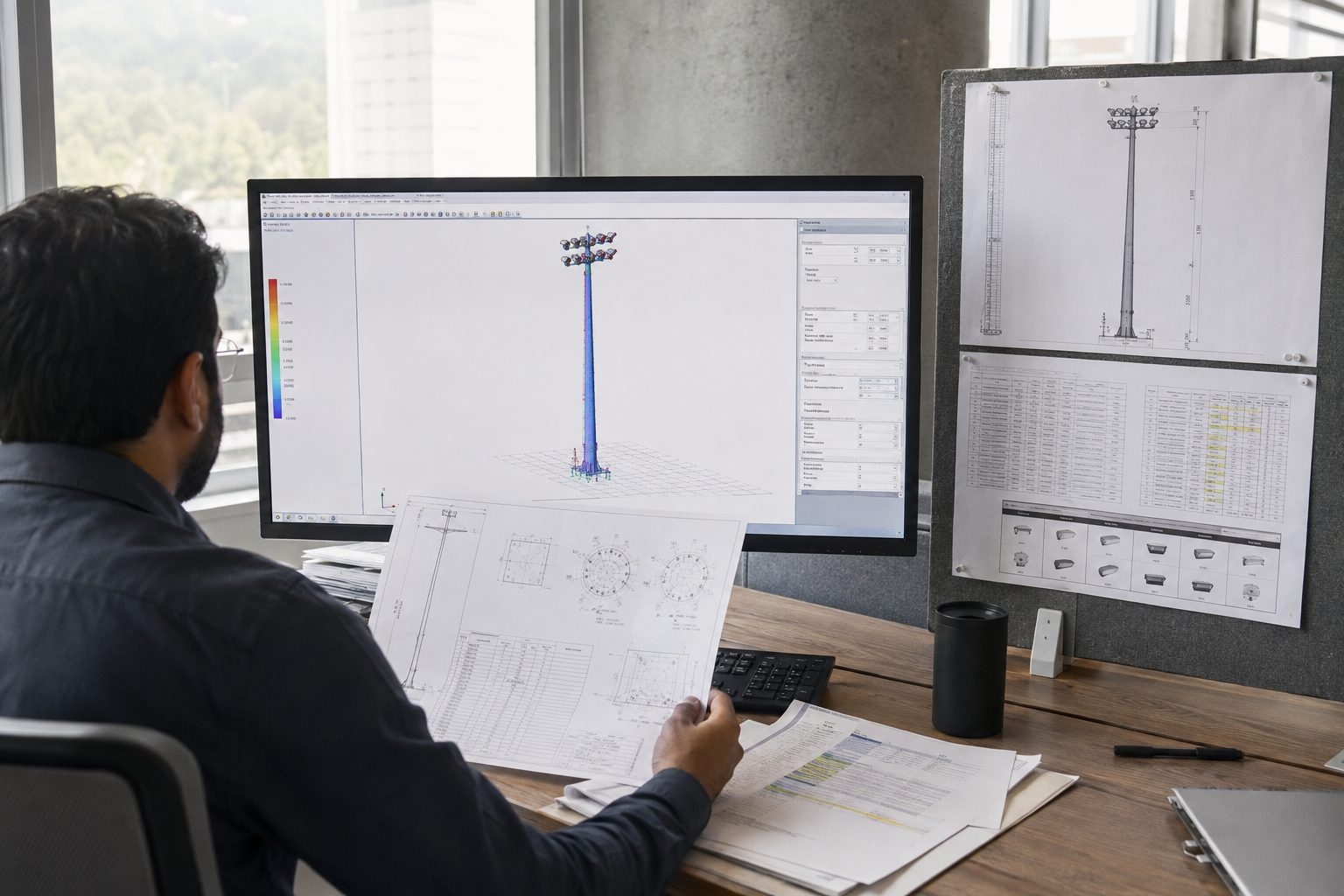
Engineer reviewing a high-mast structural model and drawings; the image does not establish the steel grade.
For wind basis and luminaire effective projected area, use the separate high-mast wind-load and EPA RFQ checklist. The material-grade comparison here should be made only after that configuration is defined.
Provide the height reference, site location and applicable design standard, wind and environmental basis, headframe/luminaire schedule including mass and effective projected area, raising/lowering or fixed-head arrangement, service access, corrosion protection, foundation interface and required deliverables. If the tender names Q345B, ask whether an edition-specific contemporary designation or alternative steel may be proposed, and define the approval route. The supplier can then return a controlled pole schedule, material certificate plan, drawings and inspection scope rather than promising one grade fits every job.
To request a project-configured high mast review, send the load schedule, drawings and material requirements through Jieyao's contact page. Final material selection and structural acceptance belong to the responsible project engineer and the governing contract.
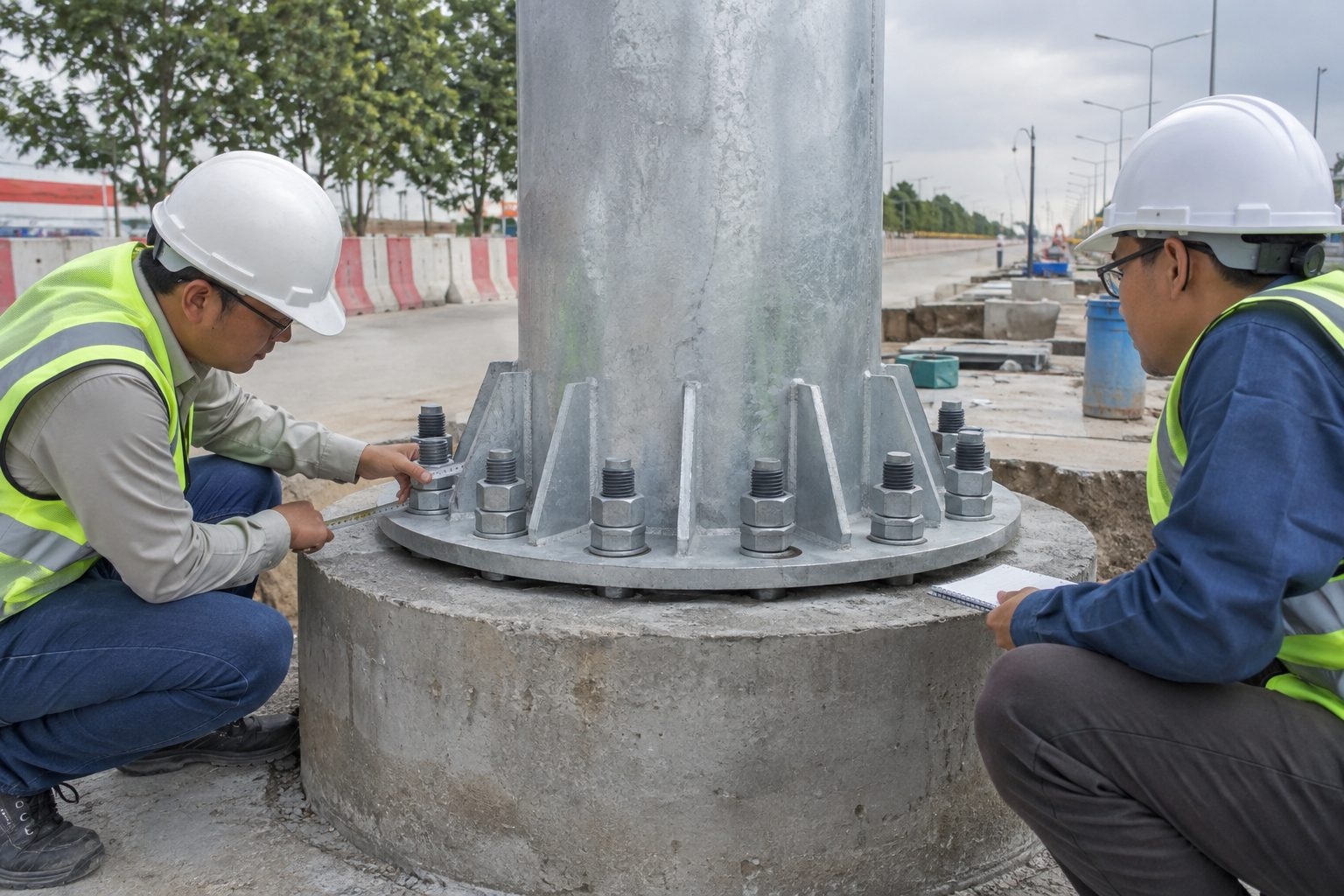
High-mast base plate and anchors require a coordinated structural and foundation design.
No universal 15 m rule is established by the grade name. The responsible designer should assess the actual load case, geometry, standard and available material, then approve the complete structure.
Do not assume exact interchangeability from similar yield-strength labels. Compare the project-required standard editions, product forms, thickness limits, chemistry, mechanical and toughness requirements, welding rules and certificates before accepting a substitution.
No. Wind capacity and serviceability depend on the complete pole design. Fatigue also depends on dynamic loading and connection/weld details; a material upgrade alone is not a fatigue remedy.
Request heat/lot-traceable mill test records for the steel actually supplied, linked to segment marks and the contract's inspection plan. The required test scope is project-specific.
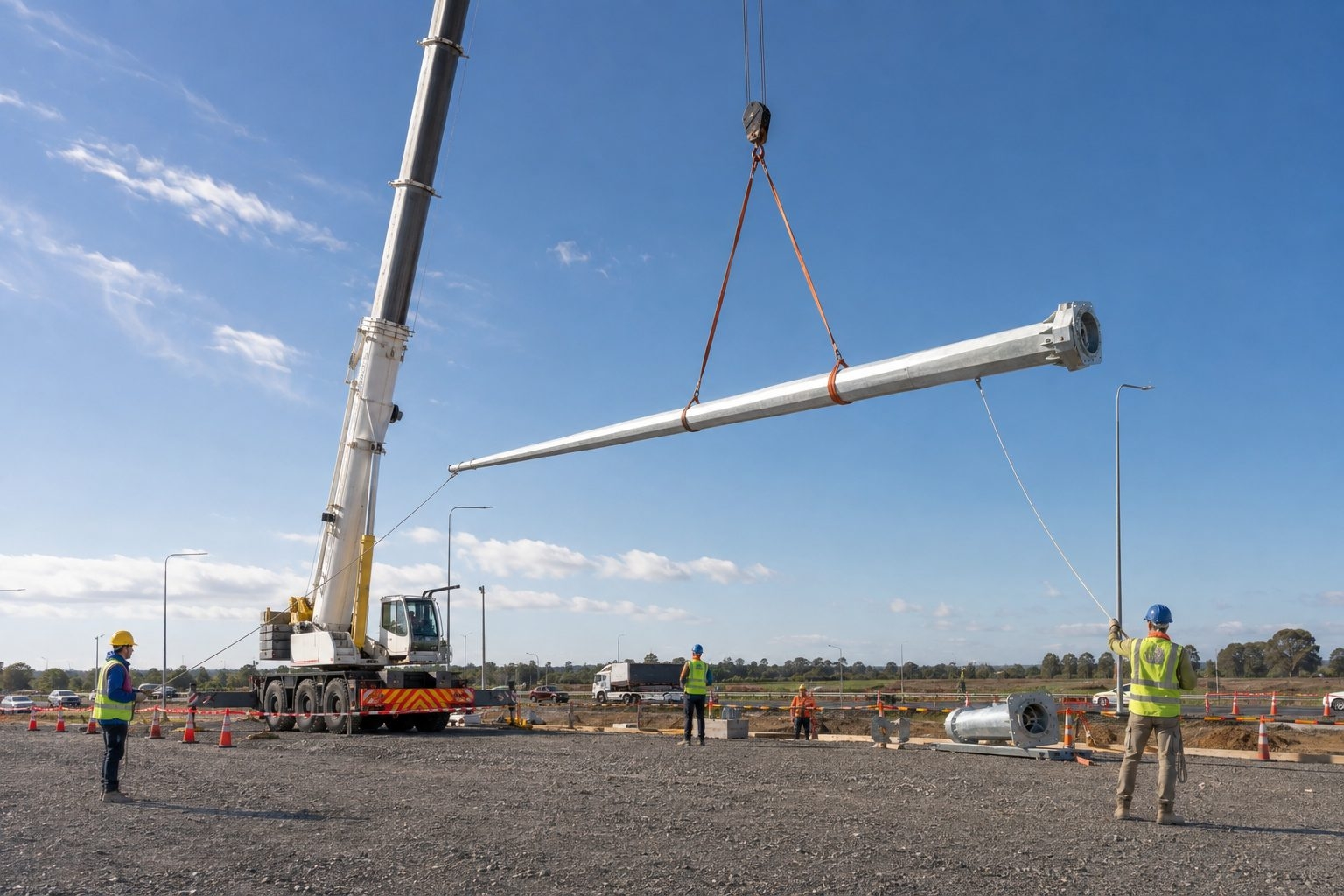
Controlled handling of a mast section illustrates the geometry and installation interface, not material certification.
Contact Us
Get a custom lighting solution and quotation for your project. Outdoor lighting manufacturer in Yangzhou, ChinaAbout Jieyao LightingYangzhou Jieyao Lighting Equipment Co., Ltd. is an outdoor lighting manufacturer focused on solar street light systems and high mas... Do you have any questions or requests?
Email: jay@jieyaolighting.com

Click to Chat.
Im online now.