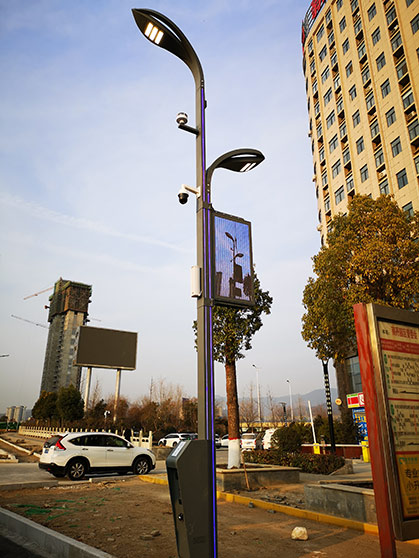


In a smart street lighting system, communication protocols are used to connect each lamp controller with the central management platform. Through this network, operators can remotely control switching, dimming, energy monitoring, and fault detection. The choice of communication technology usually depends on the project scale, installation environment, and network infrastructure.
Below are several communication protocols widely used in smart street light control systems.
LoRa / LoRaWAN
LoRa is one of the most common wireless technologies used in municipal smart street lighting projects. It provides long communication range and low power consumption. A single gateway can manage a large number of lighting nodes, making it suitable for city roads, industrial parks, and highway lighting networks. Because of its stability and relatively low operating cost, LoRa is often used when a project requires centralized control across a large area.
NB-IoT
NB-IoT (Narrowband Internet of Things) is a cellular communication technology supported by telecom operators. Each street light controller connects directly to the mobile network, allowing remote control without installing local gateways. NB-IoT is often used in smart city lighting upgrades where street lights are distributed over wide areas and stable network coverage is available.
Zigbee
Zigbee is a short-range wireless protocol commonly used in mesh network lighting systems. Each lighting node can transmit signals to neighboring lamps, creating a self-organizing network. This structure works well in urban streets, residential roads, or campus lighting projects, where poles are installed at relatively short distances.
PLC (Power Line Communication)
PLC sends communication signals through the existing power supply cables of the street lighting system. This allows data transmission without additional wireless equipment. PLC is often used in traditional street lighting retrofit projects, where the goal is to add smart control functions while keeping the existing electrical infrastructure.
4G / 5G Cellular Communication
Some smart poles and advanced street lighting systems use 4G or 5G modules for communication. Cellular networks provide fast data transmission and can support additional devices installed on the pole, such as security cameras, environmental sensors, or public Wi-Fi equipment.
In practical applications, LoRa, NB-IoT, and PLC are currently among the most widely used communication solutions for smart street lighting. The final choice usually depends on network coverage, project size, installation cost, and system reliability requirements. Selecting the right protocol helps ensure stable communication, efficient lighting control, and long-term operation of the smart lighting network.
Contact Us
Get a custom lighting solution and quotation for your project. Outdoor lighting manufacturer in Yangzhou, ChinaAbout Jieyao LightingYangzhou Jieyao Lighting Equipment Co., Ltd. is an outdoor lighting manufacturer focused on solar street light systems and high mas... Do you have any questions or requests?
Email: jay@jieyaolighting.com

Click to Chat.
Im online now.