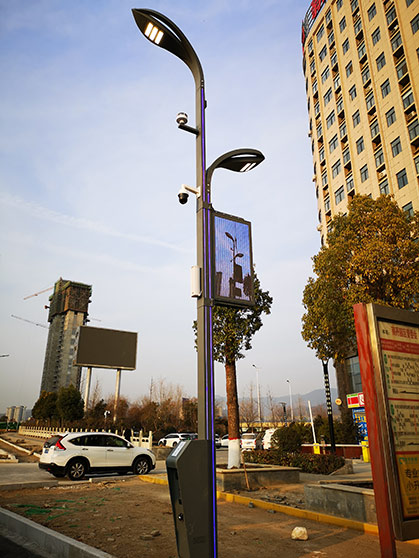


A smart pole is more than just a lighting structure. It works as a multi-functional urban infrastructure platform that can integrate several digital devices in one location. By combining lighting, communication, monitoring, and data collection equipment on a single pole, cities and project developers can reduce installation costs while improving the efficiency of smart city systems.
The most common device installed on a smart pole is the LED street light itself. Modern smart poles usually use high-efficiency LED luminaires connected to a smart lighting control system, allowing remote dimming, scheduling, and real-time monitoring. This helps cities reduce energy consumption and manage large lighting networks more efficiently.
Many projects also integrate communication equipment such as 5G small cell antennas or Wi-Fi access points. These devices help expand wireless network coverage in urban areas, transportation hubs, and public spaces. Because smart poles are already distributed along roads and streets, they provide ideal mounting locations for telecom equipment.
For safety and city management, surveillance cameras are frequently installed on smart poles. These cameras support traffic monitoring, public security, and incident management. Some systems also include AI-enabled cameras that can analyze vehicle flow, pedestrian movement, or parking conditions in real time.
Environmental monitoring is another important application. Smart poles can carry air quality sensors, weather sensors, temperature and humidity monitors, and noise detectors. These devices collect environmental data that helps city managers understand local conditions and respond more effectively to pollution or weather changes.
In transportation and public services, smart poles may also support LED information screens, traffic signal controllers, EV charging points, public broadcast speakers, emergency call buttons, and smart parking sensors. By combining these functions on a single structure, cities can reduce the number of standalone devices installed along the street.
In practice, the exact configuration depends on the project. A typical smart street lighting pole might integrate LED lighting, smart control modules, surveillance cameras, communication equipment, and environmental sensors, creating a compact infrastructure node that supports both lighting and urban data services.
Contact Us
Get a custom lighting solution and quotation for your project. Outdoor lighting manufacturer in Yangzhou, ChinaAbout Jieyao LightingYangzhou Jieyao Lighting Equipment Co., Ltd. is an outdoor lighting manufacturer focused on solar street light systems and high mas... Do you have any questions or requests?
Email: jay@jieyaolighting.com

Click to Chat.
Im online now.